
Modern Embedded Systems Are Software Products Now — And That Changes Everything
For years, embedded development was framed as a hardware problem: pick the right microcontroller, manage memory carefully, optimize for timing, and ship. That framing no longer reflects reality.
As Jacob Beningo recently observed, modern embedded development is deeply software-intensive. That single statement captures a fundamental shift that many teams are still struggling to fully internalize.
Today’s embedded systems are not defined by registers and peripherals alone — they are defined by software architecture, integration complexity, runtime behavior, and continuous evolution. In practice, embedded products have become software products that happen to run close to hardware.
This shift has major implications for how teams build systems, how organizations structure engineering roles, and how success is measured.
Embedded Development Didn’t Lose Hardware — It Gained Software
Hardware still matters. Power budgets, real-time constraints, thermal limits, and physical interfaces remain critical. But hardware is no longer where most complexity lives.
Modern embedded systems routinely include:
- Networking stacks (Ethernet, Wi-Fi, BLE, CAN, MQTT)
- Security layers (TLS, certificates, secure boot, encryption)
- Filesystems and storage management
- Remote configuration and OTA update mechanisms
- Telemetry, logging, and diagnostics
- Integration with cloud services and backend APIs
What once fit into tens of kilobytes now spans millions of lines of code. Even resource-constrained devices increasingly rely on layered software stacks that resemble scaled-down versions of distributed systems.
The result: embedded development now looks far more like software engineering than traditional firmware development.
Why Software Intensity Changes Everything
1. Complexity Moves Up the Stack
The most difficult problems embedded teams face today are no longer:
- “How do I toggle this pin?”
- “How do I save 200 bytes of RAM?”
They are questions like:
- How do we manage feature growth without destabilizing the system?
- How do we ensure secure updates across thousands of deployed devices?
- How do we debug issues that only appear in the field?
- How do we support multiple product variants without cloning code?
These are software architecture problems, not hardware ones.
2. Embedded Teams Can No Longer Be Solo Acts
The traditional model of the “embedded hero” — one engineer who understands everything from schematics to schedulers — doesn’t scale anymore.
Modern embedded products require collaboration between:
- Firmware and hardware specialists
- Software architects
- Test and validation engineers
- DevOps and build automation engineers
- Security and compliance stakeholders
This mirrors what already happened in enterprise and cloud software. Embedded teams are following the same evolutionary path — just with stricter constraints and higher consequences.
Embedded Systems Now Need Observability — Not Just Testing
One of the clearest signs that embedded systems have become software systems is the growing importance of runtime observability.
Traditional embedded workflows emphasized:
- Static analysis
- Unit testing
- Hardware-in-the-loop (HIL) testing
These are still necessary — but no longer sufficient.
Once software-heavy systems ship, real-world behavior diverges from lab conditions. Timing shifts, networks fail, configurations drift, and edge cases emerge. Without runtime insight, teams are blind.
A Modern Embedded Feedback Loop
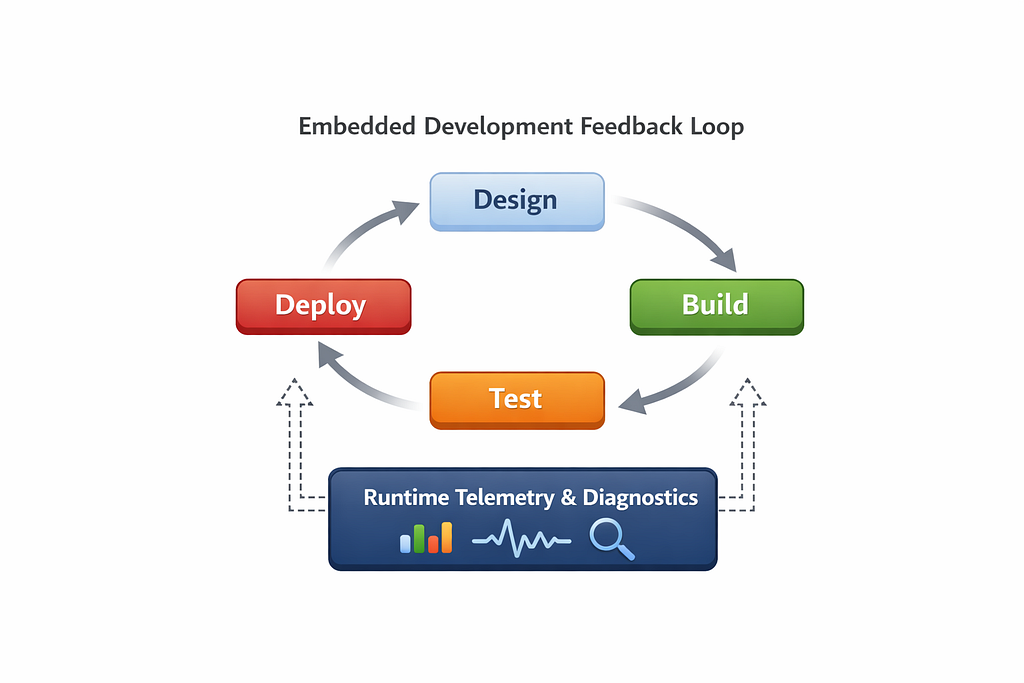
This loop — common in cloud-native systems — is increasingly essential for embedded products as well. Logs, metrics, traces, and health signals are becoming standard expectations, not luxuries.
CI/CD Isn’t Optional Anymore
As software volume increases, manual builds and ad-hoc releases break down.
Modern embedded teams are adopting:
- Automated builds across multiple targets
- Regression testing pipelines
- Artifact versioning
- Reproducible environments
CI/CD doesn’t eliminate embedded complexity — but it contains it, making changes safer and failures more predictable.
Once again, embedded development is borrowing proven practices from mainstream software engineering because the underlying challenges are now the same.
Variant Explosion Makes Software Strategy Mandatory
Many embedded products exist not as single devices, but as families:
- Automotive ECUs across trim levels
- Medical devices across regions
- Industrial controllers across configurations
Without a deliberate software reuse and variant strategy, teams fall into “clone-and-own” chaos — where fixes must be repeated, behavior diverges, and quality erodes.
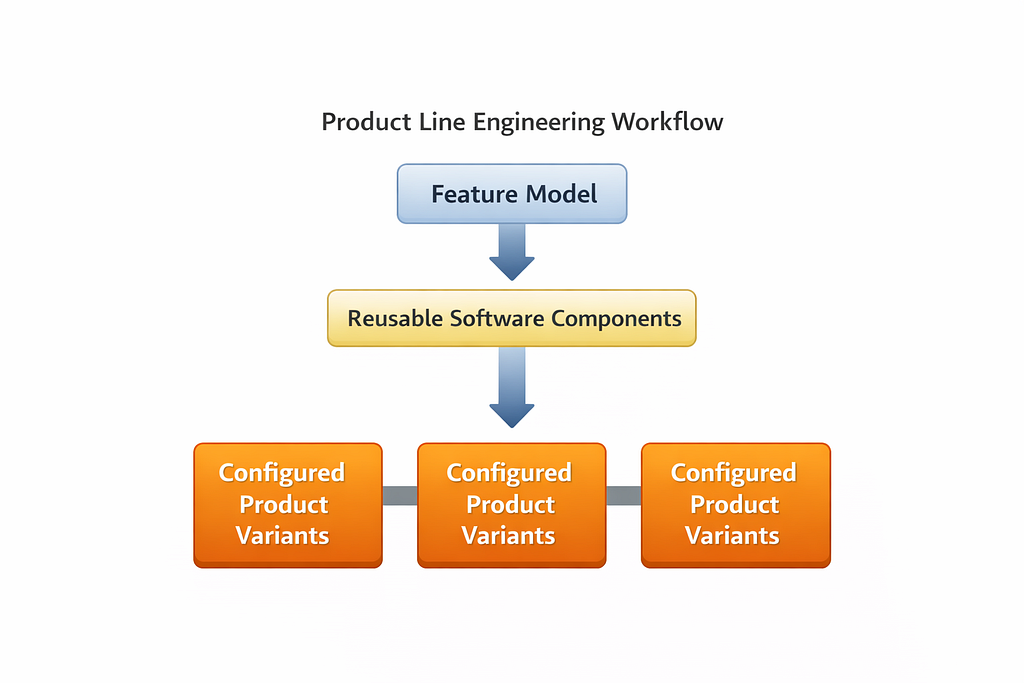
Treating embedded systems as software products enables systematic reuse, traceability, and scalability.
The Business Impact: Why This Matters Beyond Engineering
Organizations that embrace software-centric embedded development consistently see:
- Faster time-to-market
- Improved product quality
- Lower lifecycle costs
- Better compliance and traceability
- Increased ability to innovate post-launch
Those that don’t often struggle with brittle systems, delayed releases, and escalating maintenance costs.
This is not a tooling problem — it’s a mindset shift.
Embedded Is Becoming Software — Whether We Like It or Not
The takeaway from Jacob Beningo’s insight is not that hardware is irrelevant. It’s that hardware is no longer the dominant source of complexity.
Embedded systems today succeed or fail based on:
- Software architecture
- Integration discipline
- Observability
- Automation
- Collaboration
In other words, embedded development has crossed the same threshold enterprise software crossed years ago.
The teams that recognize this early — and adapt their practices accordingly — will build systems that scale, evolve, and survive in an increasingly connected world.
Now what?
Interested in learning more? Contact 321 Gang to discuss ways we can help you to improve your embedded development process.