For decades, automotive embedded engineering revolved around physical constraints:
- ECU memory limits
- CAN bus bandwidth
- thermal envelopes
- boot time
- power consumption
- real-time safety guarantees
But software-defined vehicles are introducing a new systems constraint that cuts across both OEMs and Tier 1 suppliers:
cloud economics.
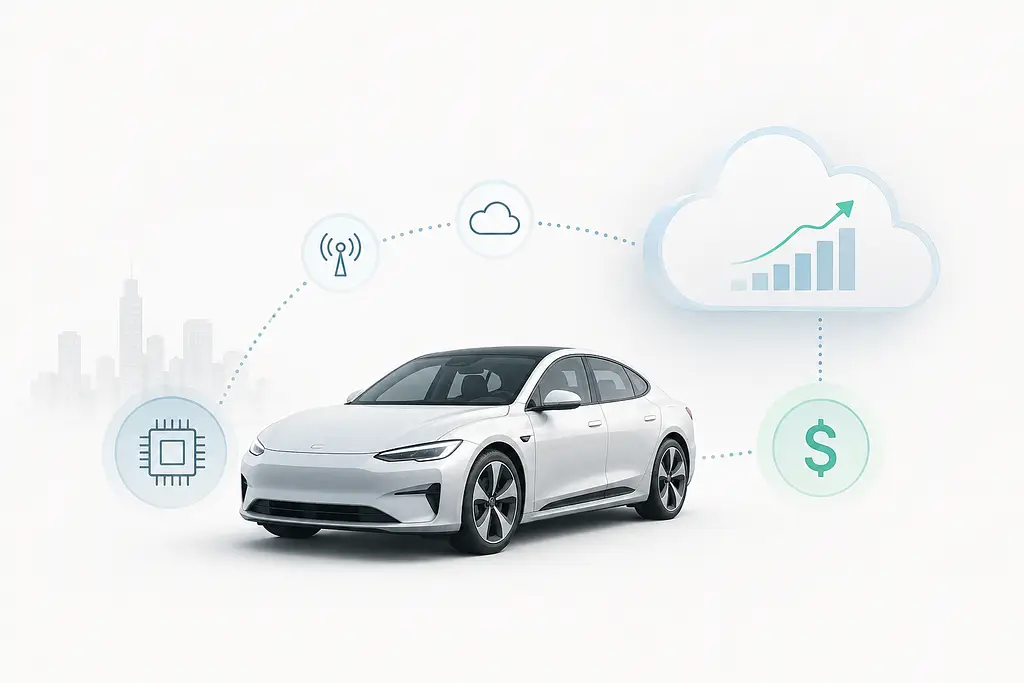
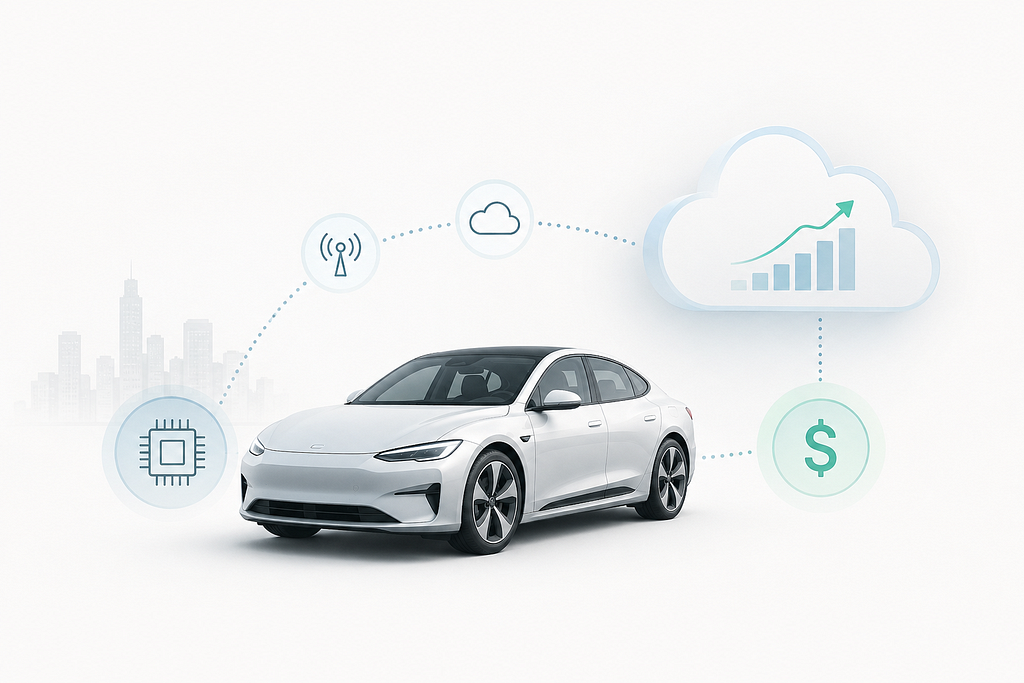
Every telemetry packet, OTA campaign, diagnostic upload, AI inference request, and vehicle event now has an infrastructure cost attached to it.
And at automotive scale, tiny firmware decisions become massive operational expenses.
The Automotive Industry Quietly Became a Distributed Cloud System
Modern vehicles increasingly behave like edge nodes in a global cloud architecture.
Volkswagen’s CARIAD platform reportedly connects more than 45 million vehicles worldwide through its automotive cloud infrastructure. (CARIAD)
Cloud hyperscalers now position connected vehicle platforms as foundational automotive infrastructure, enabling:
- OTA updates
- fleet telemetry
- predictive maintenance
- digital twins
- remote diagnostics
- feature activation
- AI-assisted driving systems
- in-vehicle services
Volkswagen’s industrial cloud initiative with AWS spans more than 120 factory sites and was designed to reduce factory and supply chain costs while standardizing digital operations globally. (AWS Case Study)
That shift fundamentally changes how embedded systems must be designed.
Historically, an inefficient firmware implementation might consume more RAM or battery.
Now it may also:
- increase cloud ingestion costs
- inflate observability bills
- drive up LTE data consumption
- trigger unnecessary autoscaling
- increase storage retention costs
- amplify OTA distribution spend
OEMs Are Discovering That “Chatty” Vehicles Are Expensive
One of the least discussed realities of software-defined vehicles is that telemetry economics scale brutally.
Consider a seemingly harmless firmware decision:
- uploading diagnostic data every second instead of every minute
- logging verbose sensor traces
- retransmitting redundant events
- storing raw rather than summarized edge data
Multiply that by:
- millions of vehicles
- years of operation
- multiple backend environments
- long regulatory retention windows
The result becomes a FinOps problem.
AWS’ Connected Mobility Solution documentation explicitly focuses on scalable telemetry ingestion, storage, event processing, and analytics pipelines for automotive fleets. (AWS Connected Mobility Solution)
But scalability is only half the problem.
The other half is operational cost.
This is why edge processing is becoming strategically important in automotive architectures.
The Automotive Edge Computing Consortium (AECC), whose members include major OEMs and cloud providers, exists largely because processing data closer to the vehicle reduces latency, bandwidth consumption, and cloud dependency. (AECC)
That’s not just an architecture decision anymore.
It’s an economic one.
OTA Updates Are Also a FinOps Problem
OTA systems are usually discussed in terms of:
- cybersecurity
- customer experience
- recall reduction
- deployment velocity
But OTA delivery is also a bandwidth and infrastructure optimization challenge.
Academic research around scalable automotive OTA architectures specifically calls out the growing cost of cellular bandwidth utilization in vehicle update systems. One proposed architecture (“ScalOTA”) demonstrated significant reductions in bandwidth overhead and download latency by redesigning how updates are distributed. (ScalOTA Research)
This matters because modern vehicles may contain:
- dozens of ECUs
- gigabytes of firmware
- increasingly frequent software releases
For OEMs, inefficient OTA strategies can create enormous recurring operational costs.
For suppliers, this creates new design pressures:
- delta updates instead of full images
- smarter update orchestration
- compression strategies
- regional rollout management
- edge caching
- failure-aware retry logic
In other words:
firmware distribution is now partially a cloud cost optimization exercise.
Suppliers Are Being Pulled Into Cloud Economics Whether They Want To Or Not
Tier 1 suppliers historically delivered:
- ECUs
- embedded software
- middleware
- AUTOSAR components
- diagnostics systems
Increasingly, they are also expected to participate in:
- telemetry architectures
- connected services
- OTA ecosystems
- cloud observability pipelines
- fleet analytics
Companies like KPIT now explicitly market integrated cloud-edge automotive data platforms designed to help OEMs monetize vehicle data and scale connected services. (KPIT)
Meanwhile, connected vehicle ecosystems built on AWS IoT, Azure Kubernetes Service, and similar platforms increasingly blur the line between embedded engineering and cloud operations. (Microsoft / CARIAD)
That means suppliers can no longer optimize only for:
- CPU
- memory
- network efficiency inside the vehicle
They increasingly need to optimize for:
- cloud ingestion cost
- observability spend
- data retention economics
- LTE utilization
- backend scaling behavior
This is especially true as OEMs push more software ownership upstream into the supply chain.
The Rise of “Cost-Aware Firmware”
Automotive engineering already treats certain constraints as first-class design requirements:
- functional safety
- thermal budgets
- power budgets
- timing determinism
Cloud cost is becoming another one.
A future vehicle platform review may ask questions like:
- What is the monthly cloud cost per active vehicle?
- Which telemetry streams actually create business value?
- What data should be aggregated at the edge?
- Which events deserve real-time upload versus delayed synchronization?
- How much observability is enough?
That is fundamentally a systems engineering problem.
And it sits directly at the intersection of:
- embedded systems
- cloud architecture
- FinOps
- systems lifecycle management
The Organizational Challenge Is Bigger Than the Technical One
One of the emerging realities of software-defined vehicles is that cloud economics rarely belong to a single team.
Embedded teams make telemetry decisions.
Platform teams manage ingestion and observability infrastructure.
Cloud operations teams manage spend.
Program leadership owns profitability targets.
Suppliers contribute software components that may indirectly shape backend costs for years after vehicles ship.
The challenge for OEMs and suppliers is no longer just building connected systems.
It is coordinating engineering, operations, and financial accountability across the entire software lifecycle.
That increasingly requires:
- traceability between requirements and operational behavior
- visibility into how software decisions affect downstream infrastructure costs
- governance across suppliers and distributed engineering teams
- tighter integration between embedded development, cloud operations, and lifecycle management practices
As vehicles continue evolving into long-lived software platforms, organizations that can connect these disciplines effectively may gain significant advantages in scalability, operational efficiency, and lifecycle cost control.
Modern FinOps platforms are also evolving beyond traditional cloud dashboards toward deeper operational visibility — helping organizations connect infrastructure consumption, engineering decisions, and business outcomes across increasingly complex systems landscapes.
At the same time, engineering lifecycle management practices are becoming more important as OEMs and suppliers attempt to maintain traceability across software requirements, architecture decisions, operational behavior, compliance obligations, and long-term supportability.
At 321Gang, we’ve seen growing interest in this convergence across embedded systems engineering, lifecycle management, and cloud financial operations — particularly in industries where connected products operate at massive scale and long service lifecycles.
Now what?
The automotive industry spent decades optimizing vehicles as physical systems.
Software-defined vehicles require optimizing them as economic systems too.
The companies that win the next decade of automotive software may not just build the smartest vehicles.
They may build the most economically sustainable ones.