The automotive industry is undergoing its most significant transformation since the introduction of the assembly line. Today’s vehicles are increasingly defined by software, with features delivered through millions of lines of code, connected services, over-the-air updates, and AI-driven capabilities.
As products become more complex, engineering processes must evolve just as quickly.
That’s where Automotive SPICE (ASPICE) comes in.
Originally developed as a framework for assessing software and systems development processes, ASPICE has become a common language for engineering excellence across the automotive industry. While many organizations first encounter it as a customer requirement, its real value lies in helping teams build higher-quality products with greater consistency, traceability, and confidence.
In the era of software-defined vehicles, the organizations that thrive won’t be those that simply pass assessments — they’ll be the ones that use disciplined engineering practices to deliver innovation faster, collaborate more effectively, and adapt to constant change.
Automotive SPICE Is About Better Engineering
One of the biggest misconceptions about ASPICE is that it’s simply a compliance exercise.
In reality, organizations that embrace ASPICE often experience benefits that extend well beyond successful assessments.
Organizations that mature their engineering processes often experience:
- Better requirements quality
- Clear end-to-end traceability
- Earlier defect detection
- More efficient testing
- Improved supplier collaboration
- Less engineering rework
- Faster audit preparation
- Greater confidence in every release
The framework encourages engineering discipline — not bureaucracy.
Done well, ASPICE becomes a catalyst for better engineering decisions throughout the product lifecycle.
The Software-Defined Vehicle Changes Everything
Modern vehicles are no longer collections of mechanical components connected by electronics. They are increasingly software platforms.
A single vehicle program may involve:
- Hundreds of engineers
- Thousands of software requirements
- Multiple suppliers across continents
- Numerous ECU variants
- Functional safety requirements
- Cybersecurity requirements
- Continuous software updates after production
Engineering teams are now expected to manage an unprecedented volume of information while maintaining complete consistency across requirements, design, implementation, verification, validation, and compliance.
The traditional approach of disconnected spreadsheets, isolated engineering tools, and manual traceability simply doesn’t scale.
As software becomes the primary source of innovation, engineering data must become just as connected as the systems being developed.
Traceability Is No Longer Optional
Ask almost any experienced ASPICE assessor where organizations struggle, and one answer consistently rises to the top:
Maintaining traceability.
Not because engineers don’t understand it.
Because manually maintaining traceability across thousands of artifacts is extraordinarily difficult.
Every requirement should ultimately connect to:
- System architecture
- Software architecture
- Work items
- Source code
- Test cases
- Test results
- Defects
- Change requests
Those relationships evolve constantly throughout development.
Without connected engineering practices, maintaining those links becomes expensive, time-consuming, and increasingly unreliable.
Conversely, organizations with strong traceability spend less time preparing for assessments because the evidence already exists as part of everyday engineering work.
Building a Connected Engineering Environment
Meeting Automotive SPICE expectations requires more than documented processes.
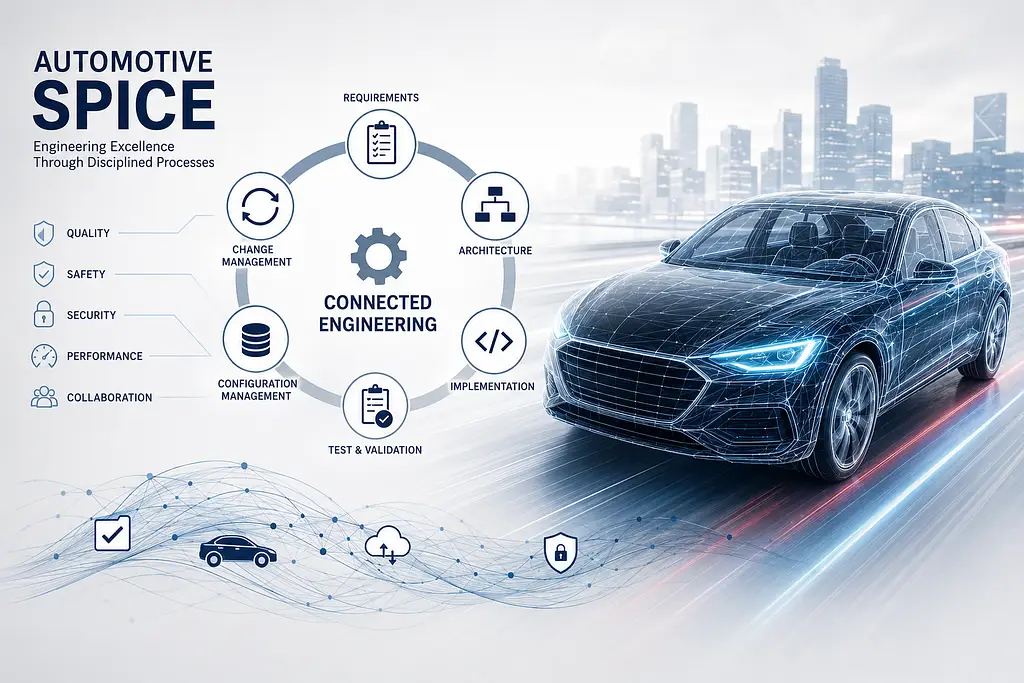
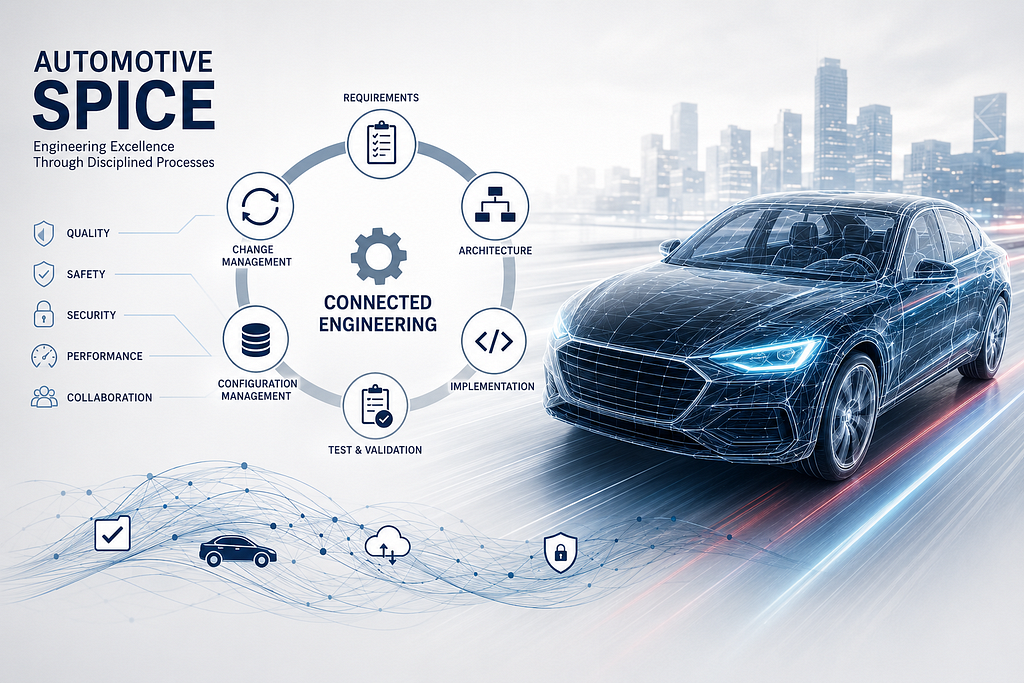
Teams need an engineering environment that connects requirements, architecture, development, testing, workflow, configuration management, and verification into a cohesive digital thread.
When engineering information remains fragmented across disconnected tools and spreadsheets, maintaining consistency becomes increasingly difficult as projects grow in complexity.
Platforms such as IBM Engineering Lifecycle Management (ELM) were designed to support this style of connected engineering.
Rather than viewing requirements management, testing, workflow, and configuration as independent activities, IBM ELM enables organizations to manage engineering information as an integrated system.
Key capabilities include:
Requirements Management
Capturing, organizing, reviewing, and managing requirements throughout the lifecycle while maintaining relationships to downstream engineering artifacts.
End-to-End Traceability
Connecting stakeholder requirements through implementation and verification to provide complete engineering visibility.
Collaborative Change Management
Managing work items, approvals, reviews, planning, and engineering activities within a shared workflow.
Integrated Test Management
Linking test planning, execution, and evidence directly to engineering requirements to simplify verification and improve confidence.
Global Configuration Management
Managing multiple product variants, releases, and development streams while preserving engineering baselines.
Individually these capabilities are valuable.
Together they provide the connected engineering foundation that increasingly complex vehicle programs require.
Engineering Is Becoming More Integrated
One of the most interesting trends visible in this year’s North American SPICE Conference agenda is the convergence of engineering disciplines.
The conversation is no longer limited to process assessments.
Conference sessions now explore topics including:
- AI-assisted engineering
- Trustworthy AI
- Software-defined vehicles
- Functional safety
- Cybersecurity
- Predictive quality
- Modern application lifecycle management
- Integrated engineering environments
That evolution reflects what’s happening across the industry.
Engineering organizations are no longer solving isolated problems.
They’re building integrated engineering ecosystems capable of supporting decades of product evolution.
Technology Alone Doesn’t Deliver Maturity
Choosing the right engineering platform is only one piece of the equation.
Successful ASPICE programs also require:
- Clearly defined engineering processes
- Governance
- Training
- Executive sponsorship
- User adoption
- Continuous improvement
- Practical implementation experience
The organizations that realize the greatest return aren’t necessarily the ones with the most sophisticated tools.
They’re the ones that successfully align people, processes, and technology around a common engineering vision.
Why 321Gang
Technology implementations are rarely the hardest part of engineering transformation.
Helping engineering organizations adopt new ways of working is where the real challenge begins.
For more than two decades, 321Gang has helped organizations modernize engineering environments supporting complex, highly regulated products.
Our team works with manufacturers and suppliers to:
- Modernize requirements management
- Improve engineering traceability
- Connect engineering teams across the lifecycle
- Streamline supplier collaboration
- Prepare for ASPICE assessments
- Implement digital engineering practices
- Successfully deploy IBM Engineering Lifecycle Management
Because we’re focused on engineering — not simply software deployment — we approach every engagement with one objective:
Helping organizations build engineering environments that continue to deliver value long after implementation.
Looking Ahead
As vehicles continue their transformation into software-defined platforms, engineering complexity will only increase.
Artificial intelligence, cybersecurity, functional safety, electrification, and connected services will demand even greater collaboration across engineering teams.
Automotive SPICE provides an important framework for navigating that complexity — not because it mandates documentation, but because it encourages disciplined engineering practices that improve quality, reduce risk, and support continuous innovation.
Organizations that invest in connected engineering today will be better positioned to develop the vehicles of tomorrow.
See You at NASPICE 2026
We’re excited to participate as a Platinum Sponsor at the North American SPICE Conference, taking place September 29–30, 2026, in Novi, Michigan.
If you’ll be attending, stop by and introduce yourself.
Whether you’re beginning your ASPICE journey, evaluating engineering lifecycle platforms, modernizing requirements management, or simply looking to exchange ideas with fellow engineering professionals, we’d enjoy the conversation.
The future of automotive engineering is being written today.
We’re looking forward to being part of it.