Tool Comparisons
Cloud cost optimization has changed.
For years, the default approach was simple: wait for a dashboard, review recommendations, open tickets, and hope teams acted before the next bill arrived. That model worked reasonably well when environments were smaller and change was slower.
But modern cloud environments do not sit still. Workloads move. Demand spikes. AI experiments appear quickly. Application teams scale services up and down. Finance teams still need predictability, but infrastructure behavior is becoming more dynamic.
That is why the real comparison is no longer just “which tool finds savings?”
The better question is:
Which approach can continuously match application demand to infrastructure supply without creating performance risk?
That is where IBM Turbonomic deserves a serious look.
The problem: cloud cost management is still hard
Flexera’s 2025 State of the Cloud reporting shows that cloud cost management remains a major challenge. Its survey of 759 global IT professionals and executives found that FinOps teams are becoming more common, with 59% of organizations reporting a dedicated FinOps team. Flexera also noted that increased cloud consumption continues to create opportunity for wasted or non-optimized spend. [1]
The FinOps Foundation’s 2025 State of FinOps report points in the same direction. FinOps is expanding beyond public cloud into SaaS, licensing, private cloud, and data center spending. The report frames this as a “Cloud+” evolution, where organizations need better predictability and understanding across broader technology spend. [2]
That matters because cloud optimization is no longer just a monthly cleanup exercise. It is becoming an operating discipline.
Native cloud tools are useful, but limited
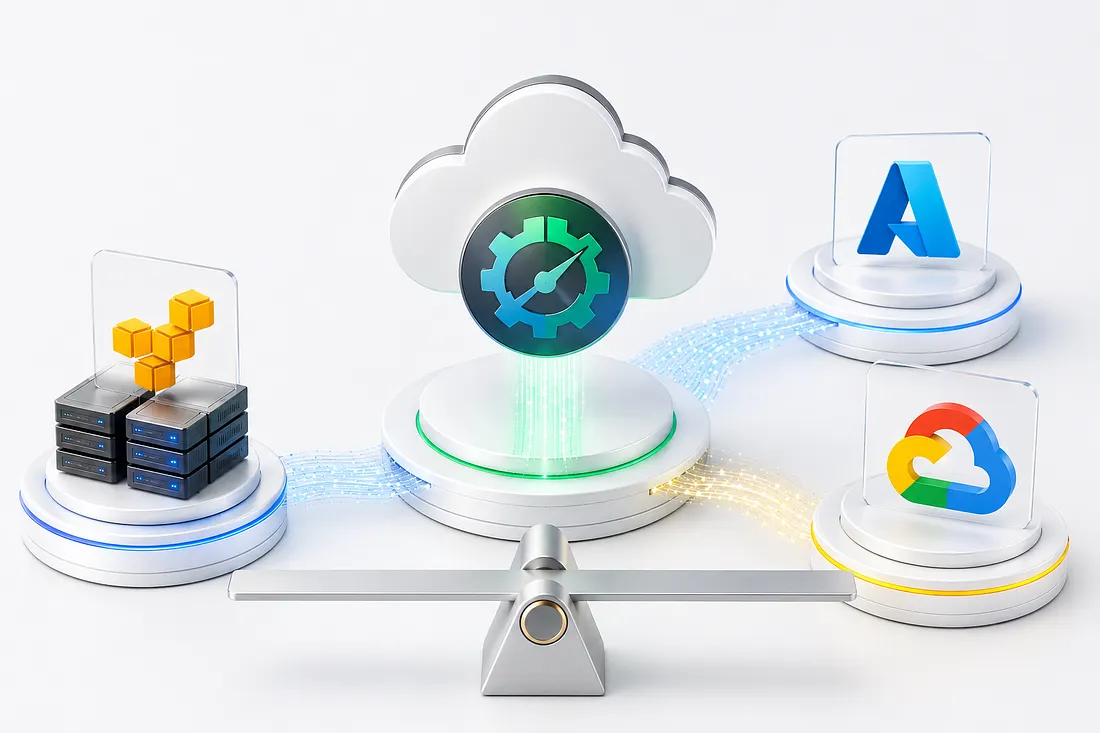
AWS, Microsoft Azure, and Google Cloud all provide recommendation engines.
AWS Compute Optimizer analyzes historical utilization metrics and recommends optimal AWS compute resources to help reduce costs and improve performance. [3]
Azure Advisor identifies idle and underutilized resources and provides cost recommendations through the Advisor dashboard. [4]
Google Cloud Active Assist can generate recommendations for areas including cost optimization, security, performance, and reliability. [5]
These tools are valuable. They are often the right starting point.
But they usually operate inside a provider-specific boundary. AWS recommendations help with AWS. Azure recommendations help with Azure. Google Cloud recommendations help with Google Cloud.
That creates a gap for hybrid and multicloud organizations. The larger the environment, the harder it becomes to coordinate optimization across clouds, data centers, containers, virtual machines, storage, and application dependencies.
The bigger issue: recommendations are not the same as action
Many cloud optimization tools are good at finding problems.
That is not enough.
If a tool says a workload is oversized, someone still has to decide whether the change is safe. Someone has to validate application impact. Someone has to schedule the change. Someone has to get approval. Someone has to execute it.
That is where optimization slows down.
The FinOps Foundation describes workload management and automation as the ability to run resources only when needed and automatically adjust resources to match demand. [6]
That is the key distinction. Optimization is not just analysis. It is an operating loop.
Where IBM Turbonomic is different
IBM positions Turbonomic as an application resource management platform, not just a cost reporting tool.
According to IBM, Turbonomic continuously analyzes applications, containers, virtual machines, and infrastructure to map dependencies and resource flows. It provides data-driven actions for workload rightsizing, capacity modeling, and policy-compliant scaling decisions. IBM also states that Turbonomic can execute safe, policy-driven actions across hybrid and multicloud environments. [7]
That is the important difference.
Turbonomic is designed to connect resource decisions to application demand. The point is not only to reduce infrastructure cost. The point is to maintain performance while avoiding overprovisioning.
That positioning matters because many organizations over-resource critical workloads for a reason: they fear performance problems. Turbonomic’s value proposition is that it can help teams make resource changes with more confidence because those decisions are tied to application behavior and policy.
The business case is stronger when automation is included
A Forrester Consulting Total Economic Impact study commissioned by IBM examined IBM Turbonomic Application Resource Management by interviewing five customers and building a composite organization. The study reported a 471% ROI and $13.16 million net present value for the composite organization. It also reported reduced on-premises infrastructure expenditure of nearly $2.3 million annually. [8]
That does not mean every organization will get those exact results. Commissioned TEI studies are models, not guarantees.
But the direction is useful: the business case is not only about savings recommendations. It is about reducing manual work, improving resource decisions, and maintaining application performance while lowering waste.
That distinction is important for enterprise buyers.
A practical comparison
Here is the simplest way to think about the categories.
Get FinOps Universe’s stories in your inbox
Native cloud recommendation tools are strong when:
- your environment is mostly inside one cloud provider
- your team wants low-friction optimization suggestions
- you are starting a basic rightsizing program
Traditional cloud cost tools are strong when:
- you need allocation, showback, chargeback, budgeting, and reporting
- finance needs visibility into where money is going
- leadership wants governance and accountability
IBM Turbonomic is strongest when:
- performance risk blocks optimization
- workloads span hybrid or multicloud environments
- teams need continuous resource decisions, not just periodic reports
- automation needs to be policy-driven and auditable
- infrastructure teams want to reduce manual rightsizing work
In other words, Turbonomic is not a replacement for FinOps reporting. It is closer to the execution layer that helps turn optimization intent into operational action.
Why this matters now
Cloud environments are becoming more dynamic, not less.
AI workloads add more volatility. Containers and autoscaling make infrastructure behavior less predictable. Hybrid architectures force teams to manage multiple layers of infrastructure at once.
In that world, monthly optimization reviews are too slow.
The winning model is likely to combine three layers:
- Financial visibility
- Engineering accountability
- Continuous resource optimization
Cloudability-style platforms help with the first two. Turbonomic is strongest in the third.
That is why IBM’s broader portfolio makes sense: Cloudability helps organizations understand and allocate spend, while Turbonomic helps optimize resource decisions closer to the infrastructure and application layer.
Final take
If your organization only needs basic rightsizing recommendations, native cloud tools may be enough.
If your organization needs financial reporting and chargeback, a FinOps platform is essential.
But if the problem is that recommendations do not turn into safe, timely action, IBM Turbonomic belongs in the conversation.
The real shift is from reactive optimization to continuous optimization.
And for complex hybrid environments, that shift may be the difference between knowing where waste exists and actually doing something about it.
References
[1] Flexera, 2025 State of the Cloud Report. Survey of 759 global IT professionals and executives. Reports that 59% of organizations now have dedicated FinOps teams and identifies cloud cost management as a top cloud challenge.
https://www.flexera.com/blog/finops/the-latest-cloud-computing-trends-flexera-2025-state-of-the-cloud-report/
[2] FinOps Foundation, 2025 State of FinOps Report. Based on organizations representing more than $69 billion in annual cloud spend and documenting the expansion of FinOps beyond public cloud into SaaS, licensing, private cloud, and data center environments.
https://data.finops.org/2025-report/
[3] Amazon Web Services, AWS Compute Optimizer Documentation. Describes AWS’s machine-learning-driven recommendations for rightsizing and optimizing cloud resources.
https://docs.aws.amazon.com/compute-optimizer/
[4] Microsoft, Azure Advisor Cost Optimization Recommendations. Documentation describing Azure’s recommendations for idle, underutilized, and oversized resources.
https://learn.microsoft.com/en-us/azure/advisor/advisor-reference-cost-recommendations
[5] Google Cloud, Active Assist and Recommender Documentation. Describes Google’s recommendation framework for cost, performance, reliability, and operational efficiency improvements.
https://cloud.google.com/recommender/docs
[6] FinOps Foundation, Workload Management & Automation Capability. Defines automated resource management and workload optimization as a key FinOps capability.
https://www.finops.org/framework/capabilities/workload-management-automation/
[7] IBM, IBM Turbonomic Product Information. Describes application resource management, dependency awareness, continuous optimization, and automated actions across hybrid and multicloud environments.
https://www.ibm.com/products/turbonomic
[8] Forrester Consulting, The Total Economic Impact™ of IBM Turbonomic Application Resource Management (commissioned by IBM). Reported results for a modeled composite organization included 471% ROI, $13.16 million NPV, and approximately $2.3 million annual reduction in on-premises infrastructure expenditures.
https://www.ibm.com/downloads/cas/6G6OBMZQ
View Tool Comparisons or contact us to discuss your FinOps priorities.