
FinOps Was Built for the Cloud. AI Has Other Plans.
How AI is turning workload placement into the next great optimization problem for enterprise infrastructure.

For more than a decade, enterprise IT had a remarkably consistent answer to almost every infrastructure question.
Move it to the cloud.
The advice was not simplistic; it was usually correct. Renting compute instead of owning it reduced capital investment, shortened procurement cycles, accelerated software delivery, and gave organizations a level of flexibility that private infrastructure struggled to match. The cloud became the default destination because, for an enormous range of business applications, it was the most economically sensible place to run them.
Artificial intelligence is not reversing that trend. It is making the answer incomplete.
Recent headlines suggest that enterprise leaders are beginning to recognize the shift. CIO Dive reported that AI is forcing many organizations back to the drawing board on cloud strategy. More than 80 percent of enterprises are revisiting their cloud plans to support AI, according to the Information Services Group research cited in the article. Around the same time, a survey commissioned by Cloudian found that 93 percent of respondents had already repatriated some AI workloads, were in the process of doing so, or were evaluating a move away from public cloud. Different organizations cite different reasons — cost, latency, intellectual property, regulatory requirements, or data sovereignty — but they are all wrestling with the same underlying question: where should AI actually run?
That question represents something larger than another debate over cloud versus on-premises infrastructure. It challenges one of the quiet assumptions on which FinOps has been built. For much of the last decade, workload placement was largely considered a solved problem. Applications belonged in the cloud unless there was a compelling reason otherwise. FinOps then focused on optimizing what happened after that decision had been made.
Artificial intelligence changes the optimization problem itself.
The next evolution of FinOps won’t be about optimizing cloud workloads. It will be about optimizing where AI should think.
Traditional enterprise applications generally care about availability, scalability, performance, and cost. AI workloads introduce additional variables that can completely reshape the economics of where they execute. Specialized GPU hardware, proprietary training data, model latency, energy consumption, regulatory compliance, data sovereignty, and intellectual property all become part of the decision. Two workloads that appear technically similar may have entirely different economic destinations.
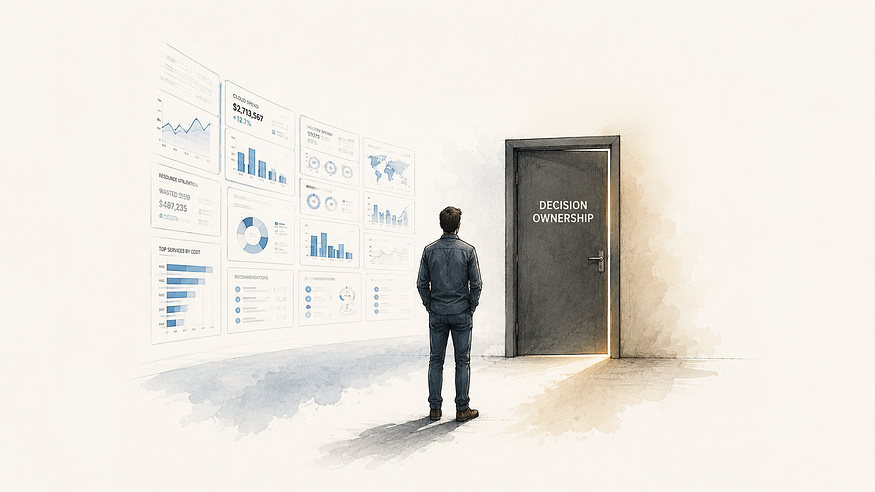
The important change is not simply that organizations are buying more GPUs or expanding private infrastructure. It is that workload placement has become an executive decision instead of a deployment decision.
That change is easy to miss because cloud remains the right answer for many organizations, especially smaller companies that cannot justify owning specialized infrastructure. Cloud services provide access to advanced models and GPU capacity without large capital commitments, and they allow experimentation without betting the company on hardware that may be obsolete before it is fully utilized. For many businesses, the economic case for staying in the cloud will remain overwhelming.
Larger enterprises face a different calculation. A workload that runs occasionally may be cheaper to rent. A workload that runs continuously at high volume may become cheaper to own. A model that uses public information may fit comfortably in a cloud service, while one trained on proprietary engineering data may need to remain inside a controlled environment. The economically sensible answer depends on how the workload behaves, what data it touches, how long it will operate, and what failure or exposure would cost the organization.
This is why the familiar cloud-versus-on-premises framing is so unhelpful. The decision is not ideological. It is architectural and economic.
Consider a software-defined vehicle approaching a construction zone. An AI model identifies a temporary lane change and recommends a steering correction. Where should that inference occur? Inside the vehicle? At the edge? In a regional cloud? The answer is not simply a technical preference. Executing the model locally increases vehicle hardware costs but minimizes latency and dependence on connectivity. Executing it remotely may reduce the bill of materials while creating an operational expense that continues for every mile that vehicle travels. Expand the question from one vehicle to a fleet of millions, and an architectural decision quietly becomes a financial one.

The same tension appears in less dramatic workloads. A manufacturer may use AI to inspect products on a factory line, where latency and reliability favor local execution. An engineering organization may train models against proprietary design history that cannot be exposed outside the company. A customer-service application may benefit from the elasticity and managed services of public cloud. A digital twin may combine all three, with local data collection, private processing, and cloud-scale analysis.
There is no universal answer because there is no universal AI workload.
This is what makes AI fundamentally different from the generation of enterprise applications that helped establish cloud-first thinking. The engineering architecture and the economic architecture are beginning to converge. Decisions about model size, inference frequency, data retention, edge processing, and hardware acceleration are also decisions about capital allocation, operating expense, risk, and long-term flexibility.
For FinOps, that creates a larger mandate.
The first generation of FinOps asked how efficiently cloud resources were being consumed. Could instances be rightsized? Should on-demand usage become reserved capacity? Was storage sitting in the wrong tier? Were teams receiving enough information to connect spending with business value? Those questions remain important, but they begin after the workload has already been placed.
AI introduces a question that comes first: should this workload be running here at all?
That question broadens FinOps beyond public-cloud invoices. Organizations will need to understand the economics of workloads that move among hyperscalers, private infrastructure, Kubernetes clusters, edge environments, and devices. They will need to compare rental cost with ownership cost, but also include factors that do not appear neatly on an invoice: power, cooling, utilization, licensing, support, operational complexity, data movement, compliance, latency, resilience, and the cost of being locked into the wrong architecture.
The result is not the end of cloud FinOps. It is the beginning of a more complete version of it.
This evolution also changes the role of observability and optimization. Understanding utilization inside a single cloud account is no longer sufficient if AI workloads move freely between public cloud, private infrastructure, Kubernetes clusters, and edge environments. Organizations increasingly need visibility into the application itself rather than just the invoice it generates. Optimization becomes less about one environment and more about understanding the behavior of workloads wherever they happen to execute.
That is where hybrid observability and application-resource optimization become commercially important. A company cannot make intelligent placement decisions if it sees cloud spend in one system, private infrastructure in another, application performance somewhere else, and business value mostly through anecdote. The harder the workload is to place, the more important it becomes to understand performance, demand, utilization, and cost as one connected system.
The discussion also changes what “savings” means. The mature goal is not to reduce spending for its own sake. It is to free resources for better investment. A company that lowers the cost of inference may choose to serve more customers, train models more frequently, improve product quality, or fund another engineering initiative. Optimization matters because it creates room to invest, not because the smallest possible bill is inherently the best outcome.
That distinction will matter as organizations build mixed AI estates. Some workloads will remain in public cloud because flexibility and access to managed services outweigh the premium. Others will move into private infrastructure because continuous demand, sensitive data, predictable utilization, or sovereignty requirements change the economics. Still others will operate at the edge because the product cannot wait for a distant data center to think.
The most capable organizations will not choose one environment and force every workload into it. They will build the ability to decide deliberately, observe continuously, and change placement when the economics change.
Cloud computing transformed enterprise economics because it changed how organizations acquired infrastructure. Artificial intelligence may transform FinOps because it changes how organizations think about infrastructure in the first place.
The next generation of technology leaders will not simply decide how much cloud they should buy. They will decide where intelligence belongs, which workloads deserve infrastructure they own, which are better rented, and how those decisions influence engineering, operations, and business performance for years to come.
Cloud computing transformed enterprise IT by changing how organizations acquired infrastructure.
Artificial intelligence may prove to be just as significant — not because it changes how we buy compute, but because it forces us to think much more carefully about where intelligence belongs in the first place.
That isn’t simply a new optimization problem.
It’s a new way of thinking about technology investment.
And that may become the next evolution of FinOps.