
The Most Expensive Cloud Decision Happens Before Anyone Opens AWS

Every architecture diagram is also a financial forecast. We just rarely draw it that way.
There is a moment in almost every engineering project that disappears almost as soon as it happens. Nobody schedules a meeting to celebrate it. Nobody writes it into the project plan. Six months later, almost nobody remembers it at all.
It usually happens in a conference room, standing around a whiteboard. Someone sketches another service. Someone suggests collecting every event because storage is inexpensive. Another engineer argues that keeping one more copy of the data “might be useful someday.” Eventually someone says, almost as an afterthought, “We’ll optimize that later.”
Everyone nods. The meeting ends. The architecture moves forward.
Months later, someone else — often someone who wasn’t even in the room — opens a cloud invoice and wonders how infrastructure became so expensive. The uncomfortable truth is that nothing went wrong. The software is simply doing exactly what it was designed to do.
We tend to talk about cloud invoices as though they arrive carrying bad news. They don’t. They are remarkably honest documents. They record engineering decisions that accumulated over weeks, months, and sometimes years: the oversized Kubernetes cluster, the AI proof of concept that quietly became a production service, the development environment nobody wanted to delete because someone might still be using it, the observability platform faithfully collecting data nobody has reviewed since the last incident.
The invoice isn’t assigning blame. It’s keeping score.
That is why many FinOps conversations begin too late. By the time people ask, “How do we reduce cloud costs?”, the architecture has already been built, the software has already shipped, and users have already come to depend on the system exactly as it exists. It is a reasonable question, but it is not the first one. The better question is: what engineering decisions quietly created these costs in the first place?
A cloud invoice reminds me of the check-engine light in my truck. I have never blamed the light. The light did not create the problem; it simply decided I should finally know about it. Cloud invoices work the same way. They do not invent inefficient architectures or unnecessary infrastructure. They reveal them, usually long after the people who made the original decisions have moved on to the next project.
Long before anyone used the term FinOps, engineers designing aircraft, automobiles, industrial equipment, and medical devices understood something software teams are rediscovering today: every engineering decision has an economic consequence, even if nobody talks about money during the meeting. A question about how often a sensor should wake, how much diagnostic data should be transmitted, how much memory is available, or how long a processor can stay asleep may sound purely technical. It is also a question about manufacturing cost, battery life, bandwidth, reliability, warranty exposure, and customer experience.
Cloud did not invent engineering economics. It simply made those economics easier to measure after deployment.
Connected products make the relationship almost impossible to ignore. An over-the-air software update does not end when the code compiles. Someone has to distribute it, monitor it, retry failed installations, support multiple software versions, and collect enough diagnostic information to understand what happened when something inevitably goes wrong. A release may last a day. Its operational footprint can last a decade.
Whether the product is a connected vehicle, a factory robot, a medical device, or a SaaS platform, engineering decisions continue consuming storage, bandwidth, compute, and human attention long after the launch celebration is over. That is not just a cloud problem. It is the economics of modern software.

One of the encouraging changes in mature FinOps organizations is that engineering teams are beginning to join conversations that used to belong almost exclusively to Finance and Operations. Not because engineers suddenly want to study invoices, but because software no longer ends when it is deployed. Every feature has an operating cost. Every service has a maintenance cost. Every architecture decision has a half-life.
Some decisions disappear when the sprint ends. Others quietly influence budgets for years.
That is why cloud economics should not be treated as something to fix after deployment. It belongs earlier, alongside performance, reliability, security, and maintainability. Changing a design before deployment is almost always less expensive than changing it afterward.
So perhaps the first question in every FinOps meeting should not be, “How do we lower next month’s cloud bill?”
Perhaps it should be, “What decisions are we making today that someone else will inherit next year?”
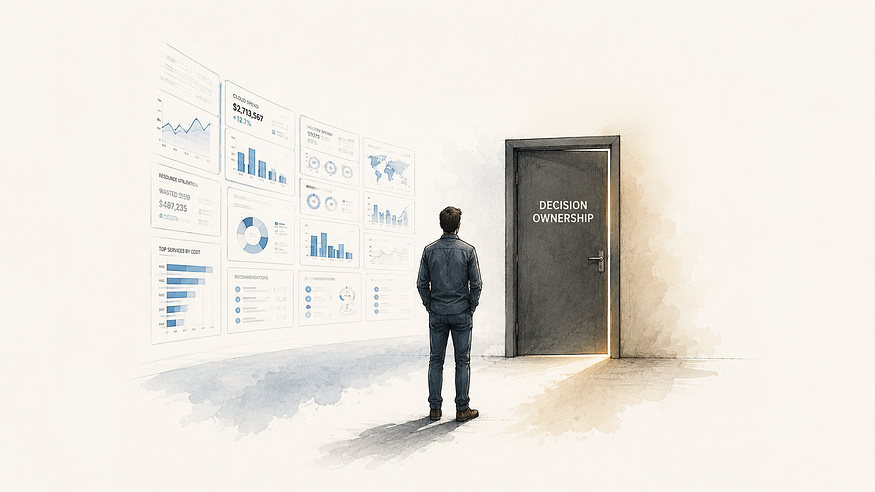
The answer probably will not be found in a dashboard. It will probably be found in tomorrow morning’s architecture review.
Things We Learned the Expensive Way.
This was one of them.
Sources
FinOps Foundation — State of FinOps Report
Flexera — State of the Cloud Report
CNCF — Annual Survey
AWS — Well-Architected Framework
Google Cloud — Architecture Framework
Microsoft Azure — Well-Architected Framework