
The Model Was Cheap. Everything Around It Wasn’t.
The first AI cost review rarely finds one expensive model. It finds an organization that never learned to count the system around it.

The AI team came to the cost review with good news. The pilot was faster than the process it replaced, users liked it, and the model invoice was lower than expected.
Then finance asked why the rest of the cloud bill had grown by several times that amount.
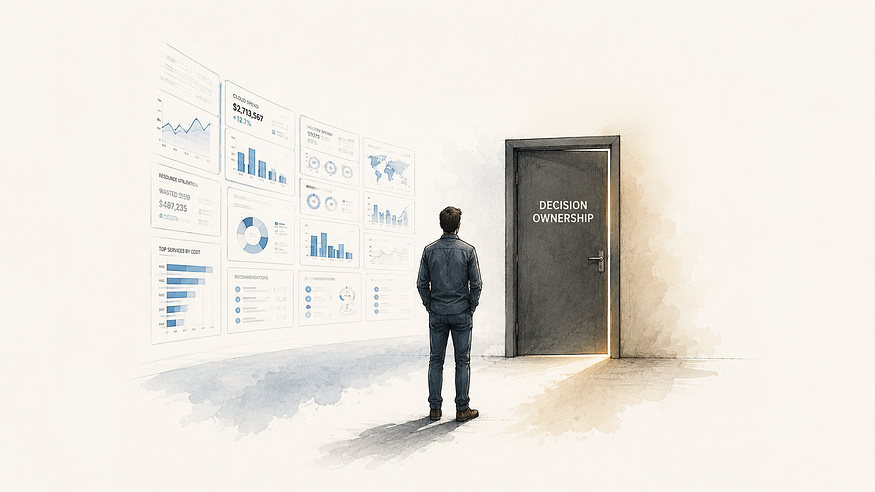
The dashboards came out. The model team showed usage. Data engineering showed storage and pipelines. Platform showed compute and the “temporary” environments that had acquired users, compliance obligations, and a renewal date. Security had controls. Operations had monitoring. Human review appeared nowhere on the cloud bill.
Every number was correct. Nobody had the cost of the product.
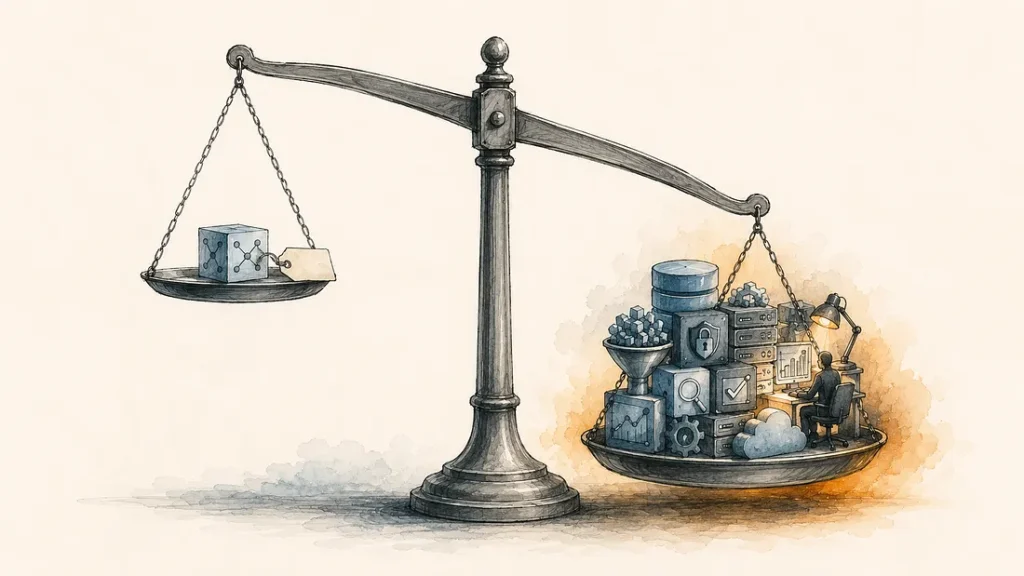
That is the expensive lesson: the model is not the product. The product is the entire system required to turn a model’s uncertain output into a trusted business outcome. When organizations count tokens and GPU hours but exclude data, evaluation, safeguards, monitoring, failed experiments, and human judgment, a cheap model can support a very expensive service.
The mistake is understandable. During a pilot, the team needs to learn whether a model can perform the task. Model choice and usage are visible, easy to compare, and directly tied to the experiment. Much of the surrounding infrastructure is borrowed, shared, or small enough to ignore.
Success changes that. A useful experiment attracts production requirements one reasonable decision at a time. The model needs current information, so the team adds retrieval. The source material needs cleaning and indexing. Answers need evaluation. Sensitive requests need filtering. A service used in everyday operations needs access controls, logs, alerts, incident procedures, and enough capacity to survive a busy Tuesday.
None of those additions proves the engineers were careless. They prove people began depending on the system. The product grew. The way its costs were measured did not.
Once the pilot becomes a working service, its cost spreads across data engineering, platform infrastructure, security, monitoring, and human review. Google Cloud and the FinOps Foundation both treat these as connected parts of AI economics, alongside model usage, performance, and business value.[1] [2] The problem is that these costs usually belong to different teams and budgets. Each team can report its portion accurately while nobody can say what the complete service costs.
The chart of accounts tells you who paid. It does not automatically tell you what the business bought.
Human work makes the gap wider. People may review uncertain results, refine evaluation sets, investigate failures, update instructions, or correct retrieved data. That labor may be exactly what makes the service safe and valuable, yet it appears as ordinary work rather than AI infrastructure. If the business case treats a generated answer and a trusted answer as the same unit, the economics improve mainly on paper.
Experiments disappear in a similar way. Teams test models, prompts, retrieval strategies, safeguards, and infrastructure because the right design is rarely obvious in advance. Failed experiments still produce knowledge, but their costs often vanish from the unit calculation for the design that survives. The organization remembers the lesson and forgets the invoice.
This is why token optimization can become a comfortable distraction. Tokens are countable, their prices are public, and the improvements are easy to show. Teams can shorten prompts, cache repeated context, route simpler work to smaller models, and reduce inference expense. Those are real savings, and the FinOps Foundation identifies them as useful levers.[2]
A cheaper model response does not always produce a cheaper result. If the answer requires more review, causes errors, or sends users back to the old process, the business may spend more despite paying less for the model.
Instead of measuring only the cost of a model call, measure the cost of completing the actual work — a resolved support case, an approved engineering document, or a problem identified before failure. Include the model, supporting infrastructure, data preparation, repeated attempts, and human review. That gives the business the number it really needs: what it costs to produce a useful result.

Measuring the cost of a useful result changes the FinOps conversation. Instead of optimizing the smallest visible line item, FinOps can help engineering and product connect architecture decisions to unit economics while the system is still changeable. Cost data needs enough technical context to guide engineering, and performance data needs enough financial context to guide investment. AWS describes this progression as moving from billing attribution toward operational telemetry for large-language-model workloads.[3]
For organizations using IBM’s FinOps portfolio, the relevant idea is not that one dashboard will uncover every hidden cost. It is that cost, operational behavior, and business ownership must be connected across the service. IBM’s Apptio guidance treats AI total cost of ownership as a broader costing problem rather than only a model-usage calculation.[4] The tools become useful after the organization agrees on where the product boundary belongs.
Back in the meeting, the model invoice was still correct. So were the storage, platform, security, and operations numbers. The team did not need another line item. It needed a larger box around the product.
The model looked cheap because the box had been drawn too tightly.