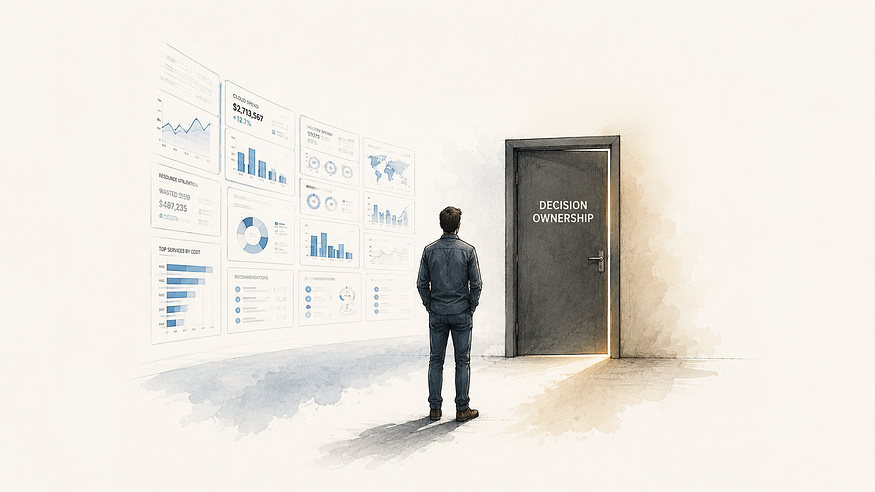

The Dashboard Was Beautiful. Nothing Changed.
Why organizations that see everything still struggle to act.

You can’t manage what you can’t measure.
It may be the most successful sentence ever written about enterprise technology.
For decades it has shaped how organizations invest in software, infrastructure, operations, and management. It justified the first network monitoring consoles, the explosion of business intelligence platforms, the rise of application performance monitoring, and today’s observability and FinOps tools.
That remains true. What has changed is the assumption that understanding naturally leads to action.
If the last twenty years of enterprise computing accomplished anything, they solved the visibility problem. Today’s engineering organizations can watch requests travel across dozens of services in real time. They know which applications consume the most cloud resources, which deployments introduce instability, which databases are approaching capacity, and which workloads become dramatically more expensive at the end of every month. Information that once required days of investigation now appears on dashboards within seconds.
The remarkable part isn’t that we can see so much. It’s that so many expensive problems remain visible for so long.
That observation appears repeatedly in industry research. Flexera’s State of the Cloud Report continues to identify managing cloud spend as one of the highest priorities for enterprise organizations. The FinOps Foundation’s annual State of FinOps report reaches similar conclusions, with workload optimization and reducing waste remaining consistent priorities even among organizations that describe their practices as mature. Neither report suggests that enterprises are unaware of where money is being spent. Quite the opposite. They suggest that visibility has improved faster than decision-making.
Perhaps we’ve spent the last two decades solving only half of the problem.
There is an understandable temptation to believe that better information automatically produces better decisions. History rewards that assumption often enough to make it feel obvious. Engineers solve defects by collecting logs. Pilots rely on instruments when weather obscures the horizon. More information usually reduces uncertainty.
But reducing uncertainty and making difficult decisions have never been the same thing.
Most engineering organizations already know far more about their systems than they can realistically act upon. They know which virtual machines sit idle for weeks. They know which Kubernetes clusters are consistently overprovisioned. They know which applications consume resources disproportionate to the business value they create. None of those observations are especially controversial inside the organizations that own them.
The difficult conversation begins one step later. Who decides that now is finally the right time to change them? That question sounds administrative. It rarely is.
Every engineering decision competes with another engineering decision. Simplifying an architecture may delay the next product release. Consolidating infrastructure introduces operational risk. Retiring a legacy application inconveniences the one business unit that still depends upon it. Reducing telemetry may save money while making tomorrow’s outage more difficult to diagnose. Every option improves one part of the system while asking someone to accept uncertainty somewhere else.
Dashboards cannot resolve those trade-offs. They simply illuminate them.
Most waste lives in the gap between seeing and deciding.
One of the more interesting lessons comes from industries that have managed complexity long before cloud computing became fashionable.
Modern automobiles continuously monitor thousands of operating conditions. Aircraft monitor even more. Industrial control systems, medical devices, telecommunications networks, and spacecraft all produce astonishing amounts of diagnostic information while they operate. Yet almost none of that information is presented directly to the person responsible for making decisions.
That restraint is intentional.
The purpose of instrumentation has never been to display everything a system knows about itself. Its purpose is to surface the handful of signals that actually change human behavior. An aircraft cockpit capable of displaying every measurement simultaneously would not be safer. It would be unusable. A vehicle that interrupted the driver with every sensor reading would quickly become impossible to operate. Engineers learned decades ago that information carries its own cost. Every additional signal competes for attention, and attention is one resource that technology has never managed to scale.
Enterprise software is beginning to rediscover the same lesson.
For years, success was measured by increasing visibility. More metrics meant better monitoring. More dashboards meant greater operational maturity. Those investments were not mistakes. Many solved real problems that had frustrated engineering teams for years. The mistake was assuming that visibility itself represented the finish line rather than the starting point.
The dashboard had done its job long before anyone looked at it. Its value would always depend upon what happened next.
The old saying was never wrong. You really can’t manage what you can’t measure. But measurement is no longer the scarce resource. Judgment is. Modern engineering organizations have become remarkably good at seeing their systems. The next competitive advantage will belong to those that become equally good at deciding what those systems are trying to tell them. Most waste lives in the gap between seeing and deciding.