AI Economics
For years, infrastructure teams treated CPU utilization as the gold standard for efficiency.
Then organizations discovered an uncomfortable truth:
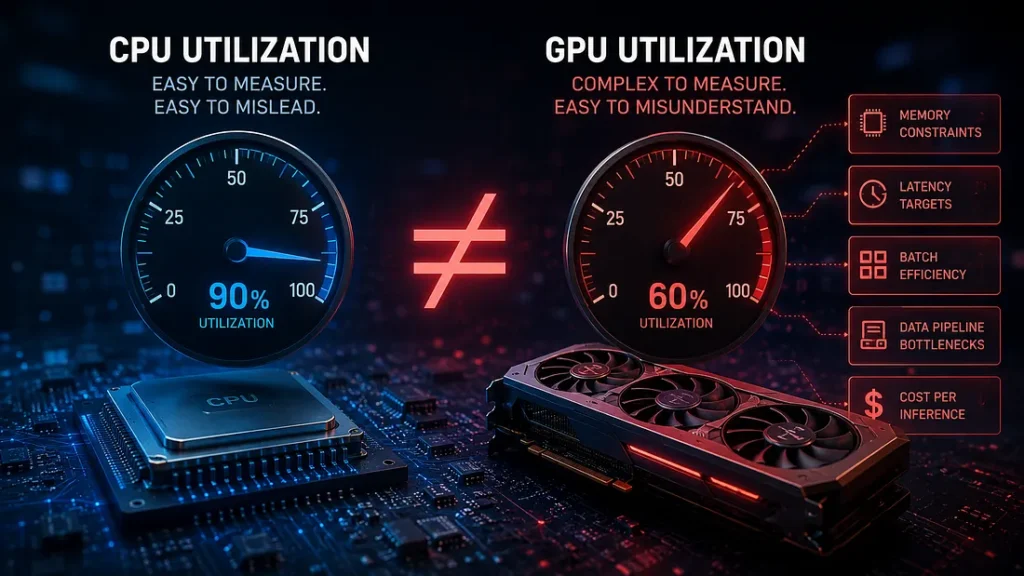
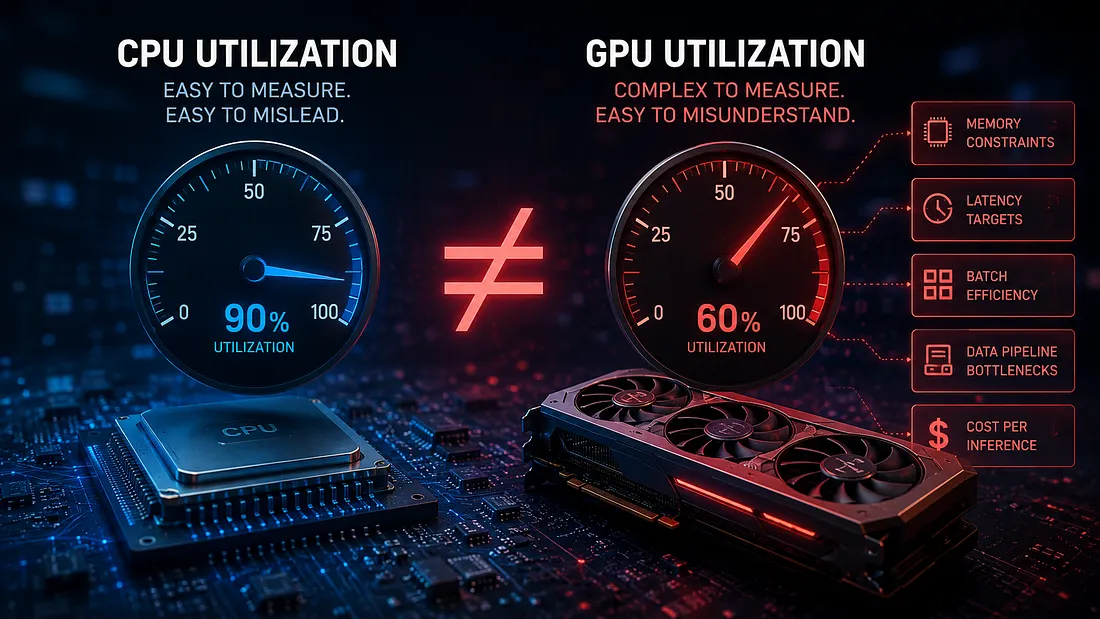
High CPU utilization does not necessarily mean economic efficiency.
Now the AI industry is repeating the exact same mistake with GPUs.
The Dangerous Simplicity of GPU Utilization
GPU utilization is attractive because it’s simple.
Executives love dashboards showing:
- 85% utilization
- 92% utilization
- “fully utilized clusters”
It creates the illusion that expensive AI infrastructure is being optimized.
But GPU utilization alone tells you almost nothing about financial efficiency.
A cluster can show:
- high utilization
- high throughput
- active workloads
…while still wasting enormous amounts of money.
Why GPU Economics Are Different
GPUs are not CPUs.
Their economics are shaped by:
- memory constraints
- batch inefficiencies
- inference latency targets
- model parallelism
- idle reservation time
- interconnect overhead
- data pipeline bottlenecks
A GPU sitting at 90% utilization may still:
- be under-serving inference demand
- process inefficiently sized batches
- wait on storage
- waste memory allocation
- operate at poor cost-per-token efficiency
This is the new infrastructure blind spot.
Utilization ≠ Business Efficiency
Here’s the real question organizations should ask:
“How much business value are we generating per GPU dollar?”
“How much business value are we generating per GPU dollar?”
That is very different from:
“How busy are the GPUs?”
“How busy are the GPUs?”
Two organizations can run identical hardware with radically different economics:
- one optimized for throughput
- one optimized for latency
- one wasting inference cycles
- one overprovisioning memory
- one serving poorly routed requests
GPU utilization alone hides these realities.
AI Teams Are About to Experience FinOps Shock
Many AI initiatives are still early enough that cost discipline has not fully arrived.
That will change quickly.
As AI adoption scales, enterprises will eventually ask:
- Which models are financially viable?
- Which inference patterns are wasteful?
- Which teams consume the most GPU spend?
- What is our cost per inference request?
- Which workloads deserve premium hardware?
And many organizations will realize:
they never built meaningful economic observability around AI infrastructure.
The Next Generation of AI FinOps
Traditional cloud FinOps focused on:
- idle VMs
- storage waste
- rightsizing
- reservations
AI FinOps will require entirely different thinking:
- token economics
- inference routing
- GPU saturation
- model efficiency
- vector retrieval costs
- latency economics
- workload prioritization
This is not just “FinOps for GPUs.”
It is a completely new operational discipline.
The Coming Shift
Over the next few years, organizations will stop asking:
“Are our GPUs utilized?”
“Are our GPUs utilized?”
And start asking:
“Are our AI systems economically efficient?”
“Are our AI systems economically efficient?”
That shift will define the next phase of infrastructure operations.
Visit the FinOps Universe blog