FinOps Architecture
Cloud promised agility. CI/CD delivered speed. But somewhere along the way, cost ownership got lost.
In engineering organizations, software is no longer deployed quarterly or monthly — it’s deployed daily or even hourly. Pipelines spin up infrastructure on demand. Test environments appear and disappear. Feature branches create temporary workloads. Containers scale automatically.
And finance? Finance still gets a monthly bill.
This growing disconnect is why many organizations feel like they are doing FinOps but not actually controlling cloud spend. The problem isn’t tooling. It’s ownership.
The Core Problem: Velocity Broke the Old Cost Model
Traditional finance and cost management models assume:
- Stable environments
- Predictable infrastructure lifecycles
- Clear ownership boundaries
- Periodic review cycles
CI/CD can break those assumptions.
In a DevOps-driven organization:
- Infrastructure now exists only as long as it’s needed
- Costs are generated by pipelines, not servers
- Environments are created by code
- Decisions are made by engineering teams, not finance
By the time finance reviews spend, the workloads that caused it may already be gone.
Cost becomes lagging data — useful for reporting, useless for control.
Cost Is No Longer a Finance Problem Alone
This is the uncomfortable truth many organizations are still wrestling with:
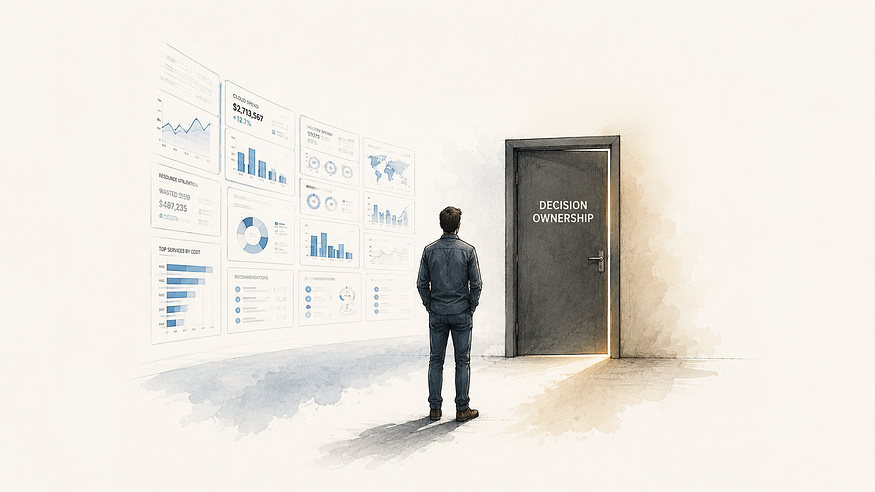
The people who can control cloud cost are not the people who receive the cloud bill.
The people who can control cloud cost are not the people who receive the cloud bill.
In many cases developers decide:
- Instance sizes
- Auto-scaling rules
- Test environment lifetimes
- Data retention policies
Platform and DevOps teams often decide:
- CI/CD pipeline structure
- Tooling and runners
- Shared services and clusters
Finance and procurement only see the result.
This doesn’t mean engineering teams should “own finance.” It means FinOps must move upstream, closer to where decisions are made.
FinOps Embedded Into Engineering Workflows
Modern FinOps is not a reporting function. It’s a control loop.
That control loop only works when cost signals are:
- Timely
- Contextual
- Actionable
That means FinOps capabilities must exist inside the same workflows engineers already use — CI/CD pipelines, deployment tooling, and operational dashboards.
When cost is surfaced after deployment, behavior doesn’t change.
When cost is surfaced during development, behavior adapts naturally.
Where Tools Like GitLab Fit: Cost Visibility Where Code Lives
GitLab is a useful example because it already acts as the system of record for modern software delivery:
- Source code
- Pipelines
- Environments
- Deployment history
When cost and usage data are tied back to:
- Projects
- Pipelines
- Branches
- Environments
Suddenly, cloud spend stops being abstract.
A developer doesn’t see “$18,000 in EC2 costs.”
They see “this pipeline configuration increased cost by 40%.”
That’s a conversation engineers can act on.
FinOps: Turning Cost Into a Continuous Signal
This is where tools like IBM’s FinOps portfolio becomes particularly relevant — not as dashboards, but as decision engines.
IBM FinOps capabilities such as:
- Cloudability (cost visibility, allocation, and forecasting)
- Turbonomic (real-time resource optimization)
are designed to close the loop between intent, usage, and cost.
Instead of asking:
“Why did our bill go up?”
“Why did our bill go up?”
Teams can ask:
“Which services, pipelines, or scaling decisions caused this — and what should we change next?”
“Which services, pipelines, or scaling decisions caused this — and what should we change next?”
That shift — from explanation to action — is the difference between FinOps theater and FinOps impact.
Automation Changes the Ownership Conversation
One of the most powerful shifts happens when optimization is automated.
With real-time optimization:
- Over-provisioned resources are corrected automatically
- Idle capacity is reduced without human intervention
- Policies enforce guardrails engineers agree with upfront
Now cost control is not about finger-pointing — it’s about shared guardrails.
Finance defines:
- Budget thresholds
- Forecast expectations
- Business priorities
Engineering defines:
- Performance requirements
- Reliability constraints
- Deployment velocity
FinOps becomes the translator, not the referee.
The New Ownership Model: Shared, Not Centralized
In a CI/CD world, asking “Who owns cost?” is the wrong question.
The better question is:
Where should cost decisions be made?
Where should cost decisions be made?
The answer:
- As early as possible
- As close to code as possible
- With automation wherever feasible
Ownership becomes distributed but aligned:
- Engineering owns decisions
- Finance owns policy
- FinOps owns the feedback loop
Why This Matters Now
As release velocity increases, cloud cost volatility increases with it.
Organizations that don’t adapt will see:
- Growing variance between forecast and actuals
- Rising friction between engineering and finance
- Cost conversations that always happen too late
Organizations that embed FinOps into DevOps will see:
- Predictable spend without slowing delivery
- Engineers who understand cost as a design dimension
- Finance teams that move from reporting to strategy
Final Thought
CI/CD didn’t just change how software is delivered — it changed where financial control must live.
FinOps isn’t about slowing teams down.
It’s about giving them better signals.
In a DevOps world, the teams that win are the ones who treat cost as runtime feedback, not an end-of-month surprise.
Visit the FinOps Universe blog