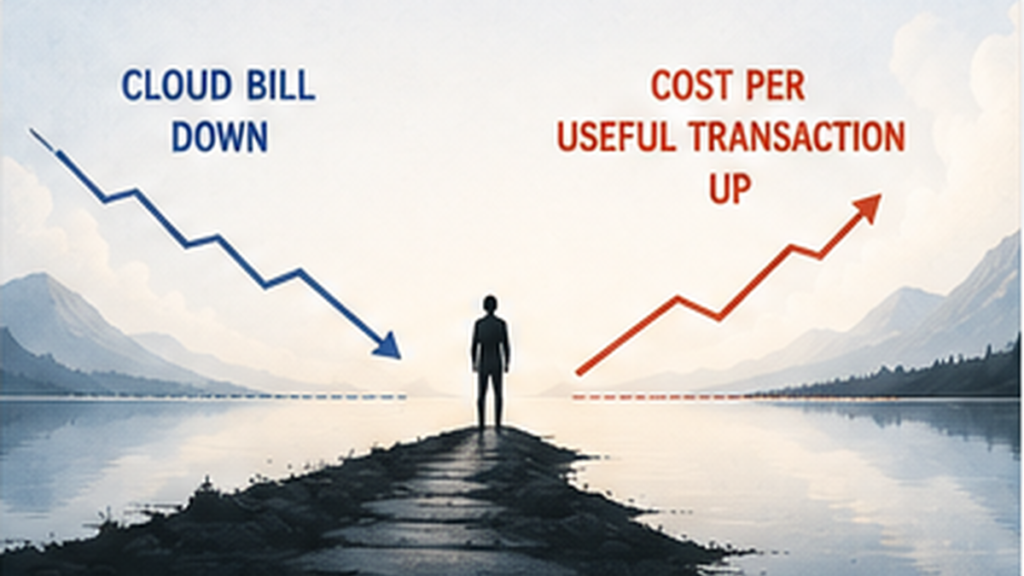

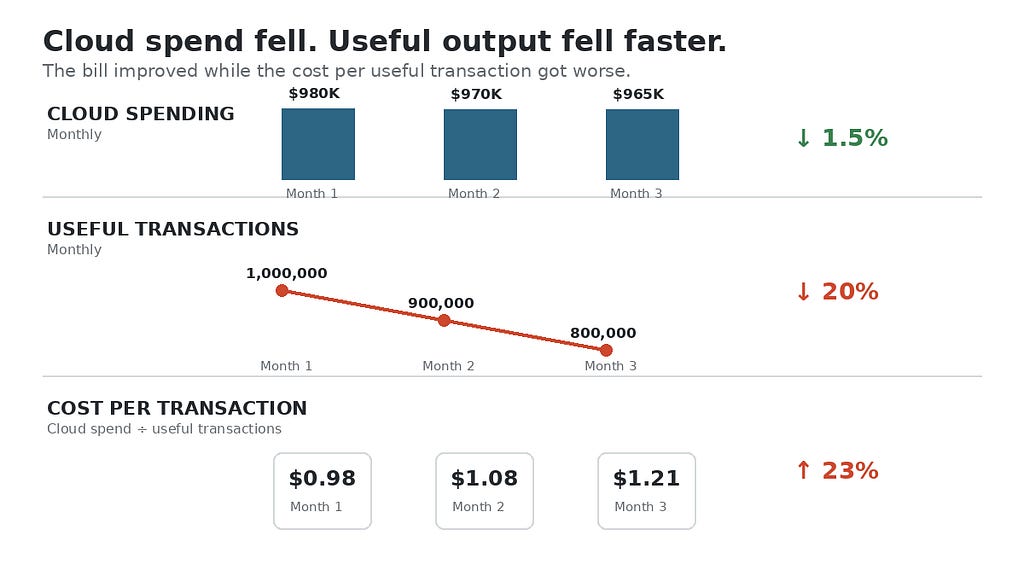
We’ve all sat in that monthly cloud review. You know the one—where everyone walks in already knowing exactly how it wraps up. For a week straight, the FinOps crew has been grinding through invoices, hunting anomalies, and tweaking forecasts. Engineering threw in their notes on idle tech and rightsizing, while Finance checked off the budget gaps. So, by the time that first slide hits the screen, there’s zero left to debate. On paper, that feels like a win. It looks like a process that actually works. Take this specific meeting: spending just dipped for the third straight month, trickling down from $980k to $970k, and finally landing at $965k. It’s no landslide drop, sure, but it took real effort to get there. The team tightened up commitment coverage, shrank some oversized workloads, and killed off a handful of legacy resources running purely on autopilot. Honestly? They saved $15,000, and they should be proud. Smart people spotted waste, fixed it without breaking the actual product, and trimmed the invoice. Most companies would just call it a day right there. They’d log the win, slap the chart into a quarterly deck, and move on to the next fire.
The cloud team has saved $15,000, and it has every reason to be happy.
The team found waste, made changes without screwing up the service, and lowered the bill. In many organizations, that would be cause for a big celebration. The savings would be noted, the chart would be noted in the quarterly report, and everyone would start looking for the next opportunity.
Then someone asks how many useful transactions the platform completed during the same three months. Oops!
The answer isn’t in the cloud report. Product tracked demand. Operations tracked throughput. Engineering knew what the services processed – the numbers existed, but no one had connected them.
But once they actually ran the final math, that $15k in savings suddenly didn’t look so great. Sure, cloud spend dipped by a tiny percent—but actual, useful output absolutely tanked by 20 percent. Look at the unit economics: the cost per transaction shot up from $0.98 to $1.21. The reality is that the cloud team did exactly what they were asked to do; they optimized the infrastructure beautifully. The problem? They were wearing blinders. They completely missed the bigger picture, failing to realize that every single meaningful transaction now carried a massive 23 percent premium.
No one had screwed-up. The dashboards were accurate. But everyone had answered a narrower question: Did we spend less?
No one had asked the question that mattered: Did we get more useful work for the money?
The bill is only half the story
Let’s be honest: just about every cloud-cost initiative starts with the monthly bill. Why? Because it’s right there in your face, it’s urgent, and somebody has to own it. Every single month, teams go through the exact same ritual—stacking it up against last month, measuring it against the forecast, divvying it up across engineering squads, and trying to explain the gaps to the executive team. Over time, companies get insanely good at playing this numbers game. They negotiate lower rates, lock in commitment coverage, kill off idle capacity, shift storage tiers, and map out allocation models. They tweak these models until they’re so ridiculously precise they can pinpoint exactly who is footing the bill for a rogue database that everyone uses, but absolutely nobody remembers spinning up.
That stuff matters. But the cloud bill in an of itself can’t tell you whether your organization is becoming more efficient at producing whatever the technology exists to produce.
A falling bill can accompany better engineering and greater efficiency or, it can also accompany falling demand, declining throughput, or a service that is simply doing less. If the report stops at spending, both can look like success.
The same problem works in the other direction. Suppose monthly cloud spending rises from $1 million to $1.2 million. A 20 percent increase is going to get attention. But if business output rises from one million transactions to 1.5 million over the same period, the cost of producing each transaction has fallen from $1.00 to $0.80.
The bill went up. The economics improved. Woo Hoo!
Ultimately, organizations chase whatever metrics they choose to value. It can be a flawed system. One team gets a massive pat on the back for cutting spending all while ignoring that the cost to actually deliver business outcome is rising. Meanwhile, a completely separate team gets flagged for blowing past their cloud budget, even though they improved the underlying infrastructure, making it more efficient. If you aren’t mapping dollars directly to output, you’re may be flying blind. Eventually, every cloud-cost debate hits a wall, forcing a fundamental business question: what are we actually dividing the bill by? The answer depends entirely on what your product actually does. Is it a successful transaction? A ticket sale? An hour of video streamed, a legal claim processed, or an instant loan decision? If it’s an internal service, you might need a completely custom yardstick.
Infrastructure teams measure infrastructure – cost per virtual machine, container, gigabyte, API call, or AI token can help understand your organization’s efficiency. Those technical measurements are not a business output. An API call can complete without resolving a customer’s problem. An AI system can use fewer tokens while creating more human rework. A claims system can process more events without settling more claims.
The easiest thing to count is not always the thing worth counting.
When a cost question becomes a business question
A great real-world example shows just how fast this conversation escapes the discussion of tech infrastructure. Take a software vendor focused on long-term care facilities and nursing homes. They bypassed generic cloud metrics entirely and picked “cost per bed” as their true north star, simply because beds actually matched how their business made money. By digging into that specific metric, they stumbled onto mismatches in how they were pricing and packaging their product. The result? They uncovered over $250k in missed annual revenue. But honestly, the $250,000 isn’t even the best part of the story. What kicked off as a boring technical debate about cloud bills grew into a strategic pivot around commercial economics, pricing tiers, and product packaging. All because they tied engineering dollars directly to what they actually sold. You could build the most hyper-precise infrastructure allocation model on the planet, and it still wouldn’t have shown you that.
That is the larger impact: organizations can control spending, meet savings targets, and optimize resources while missing a whole chunk of useful business outcome.
This doesn’t make traditional cloud optimization less important. Rightsizing, commitment management, waste reduction, architecture, etc all matter because each can reduce the cost of producing a business result.
A lower infrastructure bill proves that infrastructure became less expensive. Obviously it doesn’t prove that the business became more efficient.
Organizations do not need to boil the ocean before they can learn something useful. One important service is enough. Agree on what costs belong to it, choose an outcome that both the business recognizes and measure the relationship over time. The first few attempts will be imperfect. People will argue about which transactions count. Someone else will remember a shared platform cost that was left out. Finance may discover that Product and Operations use slightly different definitions of “completed.”
That mess is useful. It exposes assumptions that were hidden when the conversation stopped at the invoice.
Looking back at that initial monthly review, the team shouldn’t just throw away that $15k win. Those commitments genuinely locked in better rates. Getting rid of those legacy resources was absolutely the right move to trim the fat, and the engineering tweaks still carried real weight.
What changes is how the first slide is treated. The savings still belong there, but they are no longer the whole enchilada.
The next review will probably take longer. It may contain another column, and people may spend more time than to agreeing what belongs in it. That is not a distraction from FinOps; it is what happens when cloud cost gets close enough to the business to be judged by more than the invoice.
The bill has not become less accurate. The room has learned to ask it a better question.